THIS BLOG HAS MOVED!

for the time being i will keep my old posts here at blogger, but i have imported all content to wordpress. please don't abandon me! to stay updated, head on over to my new space and follow me there. thanks!

—lisa g.

Wednesday, February 20, 2013

collar stay channel tutorial

one thing my husband likes on his dress shirts are channels for collar stays. it's pretty easy to figure out by looking at a dress shirt that already has this feature, but here you go anyways!


[sorry for the following pictures to be of such poor quality. not enough sunlight, having a difficult to photograph fabric, and this ungodly orange table that i sew on are all on my list of excuses. actually, i really love the orange table. in fact i painted it that color long before i ever knew it might serve as a background for photographs.]

first cut two under collar pieces. if you don't have enough fabric to cut the second one in one piece, just cut out two halves; you really only need the outer thirds of this piece. take one of your under collar pieces and mark a line from the collar point angling up the direction you want the channel. then mark 1/4" on each side to give you a 1/2" wide channel. fold down the corner of the collar that attaches to the stand. as you do all this, make sure you check where the seam allowances will fall so that you keep the entire channel opening free from the collar stand once it is all sewn together. once you are confident you have this all worked out, trim away all but 1/2" of the folded under bit.


now you need to fill in the gap that you just folded over, so take the second under collar piece and position it under the first so that it fills in the gap. if you are not using an entire under collar and had to piece it, check the position against your pattern piece to make sure it all lines up correctly.


pin it all in place then edge stitch turning when you get to the stay channel. do this on both sides of the channel. you can trim away what you don't need of the back layer so it only covers the channel, or you can leave the entire piece attached. if you do this, i would suggest trimming off the seam allowance to reduce bulk. depending on what you like to use for stabilizing the collar this under piece could take the place or add to whatever stabilization method you prefer. i didn't trim much at this point, but later i did trim some bulk out of the point. just something to watch for. after all that is done proceed as normal to construct your collar.

i also wanted to show you what a difference it made in my collar construction by cutting the under collar smaller and stretching it as i sewed. the collar naturally curves and ultimately gives you a smoother line. had i trimmed as much width from the under collar as i was supposed to, the curve would be even more pronounced.


i was impressed anyways.

—lisa g.

Sunday, February 17, 2013

mccalls 6044 version 3.0

so last weekend we hunkered down for the

BLIZZARD OF 2013!!!

during which time not only was it difficult to leave the house, we were expressly forbidden to at risk of fine and/or imprisonment. not kidding! not that i had any intention of driving around in a blizzard, but there you have it. we got 2 feet of snow and literally had to dig our way out the front door.


so what's a girl to do while snow is falling at an alarming rate? why sew, of course!


i already had this dress shirt cut and fused and waiting for it's turn under my needle. after cutting the shirt i perused david coffin's "shirtmaking" and wanted to employ some of his techniques. while i didn't strictly adhere to his method on all points, i did pay close attention to how he does the shirt collar. while i haven't achieved perfection here, it was interesting to see how such small changes improved my collar attempt so dramatically! to me at least.


i'm not going to detail a full rundown of his methods, mostly because he does such a great job of it in his book, but also because duh! he wrote a book and it's hardly fair for me to just put it all out there on the internet. if you're not interested in owning a copy, most likely you can find it at a library. my library has a great inter-library loan service so i can get virtually any book i need. that's how i tracked down this source, though i plan to buy a copy soon to have on hand.

i'm just going to call that last buttonhole
stitched in green my signature okay?

to start, he gives you several different seam allowances to work with. he suggests 1/4" for most parts of the collar (except the edge of the collar that attaches to the stand—that you leave 5/8") which allows for more control and accuracy. i find 1/4" difficult to stitch because it falls under my presser foot, which i obviously can't see, so i went with a 3/8" SA.

he also suggests trimming width off the under collar and inner collar stand, so the under or inner side of these pieces are 1/4"-1/2" smaller than their counterpart. i find it interesting that he has you stretch the smaller piece as you sew to fit the larger piece. what i have seen before, say in tailoring a coat or jacket, is to cut the outer pieces larger then ease them down to the smaller size. do you see the difference? it's subtle, but it really works well. when you let go, the collar just naturally curves itself! very cool. i was a bit nervous and didn't trim as much as he suggested so i still have a few wrinkles. next time i'll follow more closely for sure.


i always had issues getting the rounded edge at the front on the collar stand to look good. i could never figure out when to sew that little curved bit and thankfully, coffin address this very well. no more guessing for me! all in all, the collar on this shirt is much more crisp and formed than my previous attempts. i still need some work on my collar points. i may need to invest in one of these.

i hope to make up a "how-to" for the collar stay channel soon...

i'm still not great at flat felling. i had removed most of the ease in the sleeve cap because it's quite unnecessary here and makes felling even more difficult. i think with practice i'll get a little quicker at it, but i spent f-o-r-e-v-e-r putting those sleeves in and felling them. the side seams, by contrast went super fast. it's still tedious to get all the way up or down those sleeves, but using my new felling foot at least got my stitching far more even.


inside felled armhole

inside felled sleeve seam

another thing i found interesting was how coffin recommended a very short stitch length. i had noticed while examining my husband's rtw shirts that the topstitching was done with a very short stitch, so i did this on the last shirt, but he suggests that you do all your construction with a much shorter stitch. his argument is that the shorter stitch uses more thread to go up and down with each stitch which enables the fabric to retain some of it's natural give. i noticed that i was getting slight puckering in my seams, but dialing down the tension a touch took care of that.


there are still minor changes i'll make next time around: widening the button placket (coffin recommends 1 1/4", this one is 1"), turning the under button placket to the inside instead of the outside, widening the back pleat, etc. i do feel pretty good having made three dress shirts this year, and it's only mid-february! i know more will be on my plate before long, but these are a good start. actually, i wouldn't mind making one for myself. each time i make one i keep thinking, you know with leggings and a belt i think i could wear this... focus lisa, FOCUS!

—lisa g.

Thursday, February 7, 2013

thurlow in denim

for months i've wanted to make some thurlow pants, and i finally got around to it! i went with a denim because i found some for a great price. basically (not including the pattern) these pants cost me less than $10. that's a definite win in my book!


i measure a straight size 6, but when i used this pattern before i went with a size 4. there is still plenty of room for these to be comfortable, in fact i've already spent two full days wearing them. i love this type of pant because i can look nice without being dressed up.


it does feel weird cropping out my head
so i can properly show you my bum and
then posting it on the internet... but whatevs.

any changes i made are subtle. i changed the order of construction slightly, using the method i learned from the jalie jeans pattern. it allows you to construct the fly without having the back of the pants attached yet. once the fly is constructed, and the back pieces are sewn together, you sew front to back by sewing the entire inseam and then the side seams. i really like this for a few reasons. first, you can topstitch the crotch flat, you can topstitch the inseam, and you can adjust the legs as needed to get the fit you want.


my denim is a little heavy and bulky so i needed my seam allowances to be controlled as much as possible, hence all the topstitching. i was concerned that my topstitching would detract from the look, but you can barely see it because my fabric is so dark. fine by me!

i decided to go with a single inset welt for the back pockets. i felt the double welts were a little oversized and perhaps a touch low. i made the single welt where the top of the double welt would be, if that makes any sense. i used poppykettle's fab tutorial to make my pockets and they turned out perfect. i also added a button hole just as extra insurance against unsightly back pocket gaping.


as i mentioned in my last post, i adjusted the fly extension piece so that my waistband would line up correctly and everything would be in it's proper place. i ended up trimming off the extra seam allowance in the back. as i said before, my denim is fairly heavy and it was just creating unnecessary bulk. i fit a straight size 4 so i think in the future i'll just trim the excess out to begin with.


hammered in a shank button. p.s. the dritz jeans buttons suck
big time. gonna have to find a different brand, these are
nearly impossible to get in!

i added 1" in length and they are just a touch long for wearing flats, but i figure they'll shrink up as they get washed. i can always adjust the length later as needed.

as i've said before, this is a GREAT pattern. other than tweaking maybe the front crotch depth, i really have a good fit. hopefully i can get around to making another pair (or two or three or ten) because i could really use more pants!


okay, if you don't hear from me for a while it's because i've been buried in snow. we have 18-30" (45-76 cm for you metric types) of the stuff coming our way tomorrow through saturday. blizzard! so, i'm off to stock the pantry...

—lisa g.

Saturday, February 2, 2013

it's not just you

guys, i've done a lot of un-selfish sewing lately, so it was time to sneak in a piece for myself before starting another dress shirt. i decided to make some denim thurlows. yeah, i blatantly copied not only the online sewing peeps who have made denim trousers, but even my own little sister who made a pair recently, sent me pics and generally rubbed it in my face that she made super awesome pants. really, they were so cute i just couldn't help myself anymore. i had to have my own. there's a fabric store nearby called sewfisticated (don't you just adore the name?) and every time i go there they have loads of bargains. they always have a table full of denim for $2.50/yd, and on my last visit i just couldn't pass it up. the denim they had was a little heavier than i would have preferred, but i think it still works just fine.

now, i made thurlow shorts way back when and when i did the fly, i noticed the fly extension seemed to not quite be in the right place. but i went along, leaving it as it was. then when it came time to put the waistband on, the waistband came up short. i assumed i just messed up somewhere. i made a quick fix, and all was good.

so this time around, i carefully followed the directions, and lo and behold—same problem. ah-ha! it wasn't me. it was gasp a flaw in the pattern! this time, i searched reviews because surely i wasn't the only one who came across this problem. nothing. then i asked my sister and yes! she too had the same thing happen to her. i have seen whisperings of waistbands coming up short, so i'm here to say: it's not just you! this time around, i decided to rip out all the stitching, take out the zip and start over. p.s. one of those little razor blades makes super fast work of stitch unpicking. a regular seam ripper would have taken me an hour; razor blade, less than two minutes. believe me, re-doing the zip was much less work than it sounds.


i know we all have a proclaimed love affair with sewaholic patterns, but for the sake of anyone making this pattern and having fly/waistband issues, i will stand here and be the one to let you know that there is indeed a teeny tiny mistake in either the fly extention piece or the directions. fortunately, it is a super easy fix.

if you need what you are sewing to look exactly like the directions, trim 5/8" off the width of the fly extension when you go to finish the long edge (or trim it from the pattern piece to begin with). after, you can continue following the directions and illustrations as they are.


please note that i reversed my fly to the
standard zip up with the right hand layout

if you are confident enough to have yours look slightly different, sew the zip at 5/8" in from the facing edge instead of lined up with it. then when you sew the zip and fly extension to the pant, line up the edge of the zip tape (instead of the edge of the facing) with the edge of the pant. i kind of like the facing to extend beyond the edge of the zip tape to minimize bulk, so that's what i did.

all in all, it's not a big deal. i do wish sewaholic would put a little note amending the pattern either as an insert or on the site somewhere, especially since we're talking about the fly. many people are using this pattern as their first try at pants and we're all assuming that we have erred somewhere. i love sewaholic and tasia is an absolute dear who works very hard and delivers an outstanding product, but just a teeny tiny little amendment would be fab.


again, my zip is reversed from how the pattern is written
that's just how i roll

that's my PSA for the day. carry on.


—lisa g.

Wednesday, January 30, 2013

my first jean-like pants

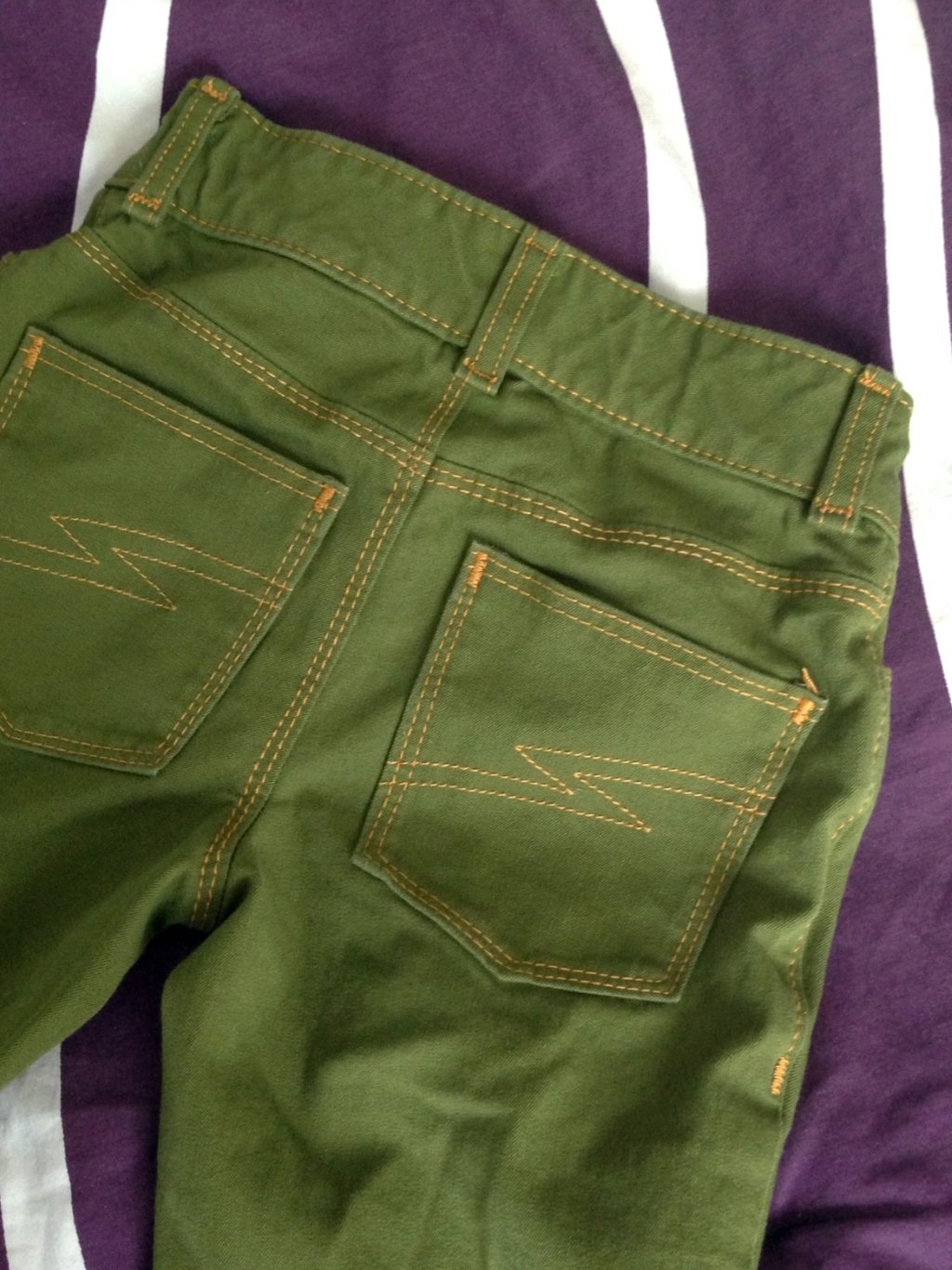
i've made pants and shorts before, so i'm pretty comfortable with the whole process. still, i've put off making any actual jeans. but as with many of my sewing adventures, i try new stuff out on my kids first. i picked up this green stretch twill for pretty cheap and was dying to try out the famed jalie #2908. if you don't know jalie patterns, they specialize in all things stretchy and active, and each pattern comes in approximately 5,987,423 sizes. since i've been into tracing patterns lately, i was okay with this.


i set off tracing each piece suuuuuupeeeerrrrr carefully. the pattern has 3/8" SA, so there isn't much room for error. overall the directions are very good and i didn't need many changes. she wanted a skinny pant so i narrowed the legs in for a custom fit. hey, every kid needs custom fit pants, amiright? i started out by cutting a straight leg so i could taper as needed. i ended up taking in the seams by about 3/8" below the hip, and 5/8" from the knee down.


other changes were pretty minor. i added one of those little change pocket things, which i stitched onto the facing before assembling the front pockets. i made up a separate fly facing instead of the folded in variety, and cut a separate inner and outer waistband. i feel both of these are sturdier when cut separate instead of just folded. the pattern has a seam at the CB of the waistband, i'm not sure if this is just to save fabric or what. the waistband is a straight rectangle, so if/when i make her another pair i'll eliminate the back seam.


i topstitched throughout to mimic RTW and even added a regular jeans hammer it in shank button. i don't have pics of the shank button because initially i had sewn on a regular button because she was so eager to wear them and i hadn't bought a jeans button yet. the shank button makes all the difference in the world for that real look. plus you get to hammer stuff. which is fun. next time i think i'll try rivets too.


she wanted a lightning bolt design for the back pocket because she is a huge fan of the "percy jackson and the olympians" series (one is entitled: "the lightning thief"), not to mention harry potter.


i thought i would give you a comparison between these and a RTW pair. she usually wears an 8 slim, so i decided to make a size 7. in retrospect, i should have cut the waistband and length in size 8, then slimmed down to a 7. they're long enough for her, but an extra inch wouldn't have hurt!

so here they are next to a 7 slim skinny jean from old navy. it looks like the sizing would be very consistent with RTW, though the waist may be a tad snug by comparison.


the only thing that really bugs me is the giant back pocket. see how much larger it is than the ON jean? HUGE! i didn't even think about this before stitching it on. i will definitely make a smaller pocket next time.


after this i feel pretty confident to make some jean-like pants of my own. i'll want to alter some of the SA's for a proper flat fell in places, but overall this is a really nice pattern. call me crazy, but i've been oogling over all the floral/patterned skinny jeans for spring. it's hard to track down floral stretch twill in a pant weight, but i finally found some online at mood... if i feel daring enough, i'm tempted to make my own!

—lisa g.

Sunday, January 27, 2013

mccalls 6044: version 2.0

it's tricky to get interesting-looking shots of an un-modeled men's white shirt (i should probably at the very lest get myself a nice hanger) but here you go anyways. i finished this last week right before my husband had to take off for the weekend on business. to las vegas. wah-wah...


this is one of two shirts i cut out for my husband, this time dress shirts for work. there is a dive fabric shop nearby that has amazing deals and i picked up some white and light bluish grey shirting for $2.50/yd. since i'm still learning all the tricks i'm not ready to splurge on the $10-$20/yd quite yet.

i made the white shirt first with a couple fit and design alterations. i widened the neck by about 5/8". when i had him button the top button on his first shirt, it was definitely too small for tie-wearing. also, the sleeves were a touch long, so i shortened the sleeve by 1/2".

if you squint you can see the collar-stay channel i added

then i did the front placket different. i extended the center front of the shirt front so i could attach the placket at the edge then fold it onto the front, then top stitch. it's a small change, but it requires less blind precision and eliminates hand stitching the placket from the inside.

i went ahead and flat-felled the sleeve/shoulder seam as well as up the sides and down the sleeve. surprisingly not as hard as i thought it would be! i just ordered a felling foot to make this stitching a little more precise in the future though. it's damn near impossible to hide imperfect stitching on a light solid colored fabric, let me tell you.


i decided to track down the ultimate resource in shirtmaking, aptly titled "shirtmaking", by david coffin. since the husband has tasted the fruits of custom clothing there's just no going back. i've glanced through the book and there is so much information to absorb. he has great techniques for all the tricky bits and i will no doubt rely on this book heavily.

i had promised a sleeve placket tutorial to go with my pattern piece, but i made this one in the evening and had no adequate lighting. i'll make sure to do the next one during daylight hours for your benefit. it did turn out rawther well, i think.


overall i'm pleased with how the shirt came out. the fabric weave is looser than a lot of shirting so i had some issues and struggles all throughout. the next one has a very tightly woven fabric so i think it will come together a bit easier. even though i have it cut out, fused and ready to go, i have another project i've already started: thurlow pants in denim! the shop that i picked up the shirting fabric at always seems to have a pile of denim for $2.50/yd and i finally picked some up. plus i have an unblogged pair of pants i made for my daughter... ack! it's only the end of january and i'm already getting behind in posting!

—lisa g.

Friday, January 25, 2013

rayon bias facing: the "no swearing necessary" method

okay, you asked so i'll share...

if you've ever tried to use rayon bias tape for a facing, you'll know how tricky it is. it shifts, it frays, it's generally uncooperative. before my portrait blouse, i had done it twice: the first time was a bloody mess, the second time took for-ev-er! and still didn't look that great. so i was searching my pile of scraps for a lightweight cotton or basically anything that would work as bias facing. nothing. okay, fine. [deep breath] i'll use self fabric.


i didn't take pics when i constructed the blouse, but i used scraps to show you my method.

leave the full 5/8" seam allowance on the neckline of the blouse and stay stitch at 1/2" (or just inside the SA) directionally from the shoulder down to center front, then shoulder to center back. make sure you overlap those last few stitches at CF and CB. stay stitching makes a world of difference, trust me!


cut your bias tape to 1 1/4" in width, then serge one edge with 1/4" wide serging. if you are living in a cave and don't have a serger, take your bias tape and press one side in by 1/4".


line up the edge of the blouse with the edge of the non-serged (or pressed) edge of bias tape and sew at 5/8". don't bother pinning the bias tape all the way around first, just go slow and keep adjusting the bias tape as you go around curves. don't stretch the bias tape or you will end up with a puckered seam.


once it is attached, trim the seam allowances down to 1/4".


press the seam flat first in order to shrink back any stretching that may have occurred and to eliminate any wavy-ness at the seam.


now lift the bias tape out flat and press the seam open from both sides. this will give you an good clean edge.


press in the serged edge of the bias tape using the serging as a guide, or re-press the 1/4". seriously though, get a serger.


now turn the bias facing into place and press. pin as little as possible perpendicular to the bias tape. excessive pinning or pinning parallel to the bias tape can distort the seam and if you have adequately pressed along the way, you won't need many pins.


finally, topstitch at a scant 1/4". i find that if i move my needle to the left position i can get 1/4" by lining up the right edge with the edge of the opening on my presser foot. i tried using my 1/4" piecing foot as a guide, but it was just a smidge too wide.


now you have a perfectly bias-faced edge!


this may seem like a lot of little steps that take too long, but in reality it goes very fast. if you half-ass or skip any of the pressing steps, it will take much longer and not look as nice. true story.

—lisa g.